
Philadelphia CCP Discovery Motions now in Person!
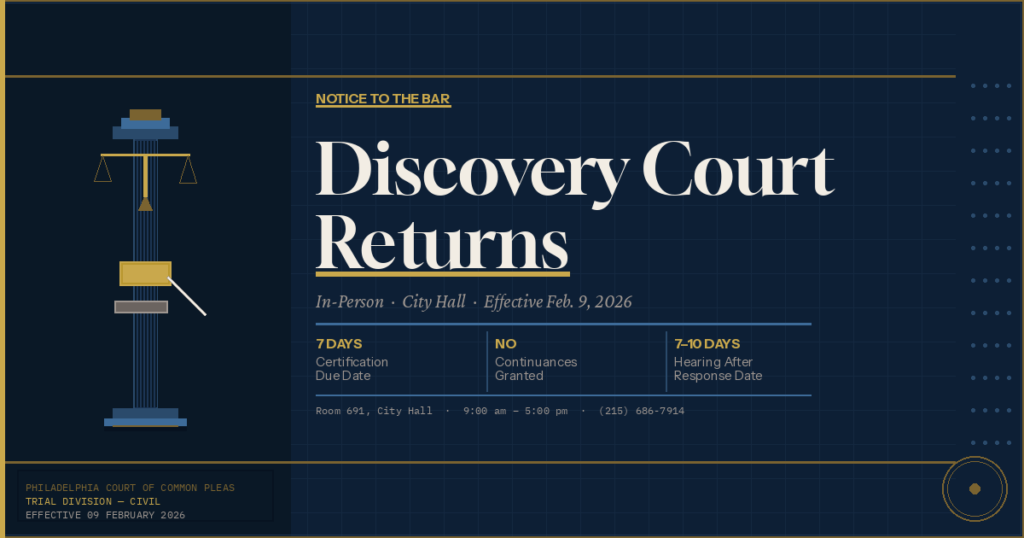
The Philadelphia County Court of Common Pleas has announced that discovery motion hearings will now go back in person. Personally, this is a welcome development. As a young attorney, this was the way for me to learn how to practice in front of a judge. They have streamlined the system so there are no 100+ long motion lists, and you get to see Pete Divon work his magic again. Win-win.
The Big Change: In-Person Only, Effective February 9, 2026
Effective Monday, February 9, 2026, all contested Discovery Motions in the Philadelphia Court of Common Pleas, Trial Division – Civil, will be scheduled for in-person hearings in the assigned Judicial Team Leader’s courtroom. Remote participation via Zoom is no longer permitted. All necessary parties and counsel must appear in person.
The Discovery Court Program is located in Room 691, City Hall, and operates Monday through Friday, 9:00 a.m. to 5:00 p.m. Questions can be directed to Peter Divon, Director, at 215-686-7914 or Peter.Divon@courts.phila.gov.
The Hearing Schedule by Program
Hearings are assigned based on the type of case and the year in which the case was filed. Here is the current schedule:
Tuesdays at 9:00 a.m. — Major Jury cases from 2025 & 2022, Courtroom 232 (Judge Carpenter)
Tuesdays at 10:00 a.m. — Commerce cases, Courtroom 636 (Judge Crumlish)
Tuesdays at 1:00 p.m. — Major Jury cases from 2026 & 2023, Courtroom 253 (Judge Bright)
Wednesdays at 9:00 a.m. — Major Jury cases from 2024 & 2021, Courtroom 480 (Judge Cohen)
Wednesdays at 10:00 a.m. — Commerce cases, Courtroom 646 (Judge Erdos)
Thursdays at 9:00 a.m. — Arbitration, Arbitration Appeals, and Major Non-Jury cases, Courtroom 602 (Judge Roberts)
Thursdays at 10:00 a.m. — Commerce cases, Courtroom 630 (Supervising Judge Patrick)
Important: No continuances will be granted. Make sure you have the correct date, time, and courtroom before you show up.
The Filing Protocol: What You Must Do After Filing a Discovery Motion
The court has put a clear step-by-step protocol in place for all discovery motions. Once you file a discovery motion through the Civil Electronic Filing System (EFS), the Office of Judicial Records will set a Certification Due Date of seven (7) days from the filing date. By that deadline, the movant — not the respondent — must file the appropriate praecipe and certification in the Discovery Court Filings section of EFS. Here is how that breaks down depending on the posture of your motion:
Withdrawn: File a Praecipe to Withdraw identifying the control number, the parties, and the relief sought.
Resolved by Agreement: File a Praecipe to Enter Discovery Order By Agreement, along with a proposed order marked “BY AGREEMENT” and a certification that opposing counsel has consented. Retain written proof of that agreement.
Uncontested: File a Praecipe to Enter Uncontested Discovery Order with a proposed order marked “UNCONTESTED” and a certification confirming no opposition. Again, retain written proof.
Contested: File a Praecipe for Contested Discovery Motion confirming that you have conferred or made reasonable efforts to confer with opposing counsel and were unable to resolve the dispute.
Note: If you cannot reach the respondent to get their position, the motion is presumed contested. Also, if you fail to file any praecipe or certification by the deadline, the motion will be marked dismissed without prejudice.
What Happens When a Motion Is Certified Contested
Once the movant certifies a motion as contested, the respondent has until the established Response Date — seven (7) days from the Certification Due Date — to file a response through the EFS Discovery Court Filings section. If no response is filed, the motion will be assigned to a judge for review as unopposed. If a response in opposition is filed, the motion will be listed for an in-person hearing approximately seven to ten days after the Response Date expires. The Office of Judicial Records will notify all parties of the hearing date, time, and courtroom.
Filing Through the Civil Electronic Filing System (EFS)
All discovery-related filings must go through the Discovery Court Filings section of the EFS — not the general Motions section. From the main menu, click the “Discovery Court Filings” link, select Trial Division-Civil, and enter your nine-digit case ID. You will then select from the following filing categories: Discovery Motions; Answers/Responses/Replies to Discovery Motion; Certification Regarding Discovery Motion; or Withdraw Discovery Motion.
A filing fee applies only to the initial Discovery Motion. No subsequent filings in connection with that motion carry a fee. Payment must be made by credit or debit card through the EFS — walk-in counter payment is no longer available.
When filing a response or certification, you will be prompted to select the specific open motion you are responding to from a list. Be careful — you must select the correct motion, and you must file separately for each open motion you are addressing. One responsive filing cannot cover multiple open motions.
Your Service Obligations
After filing, it is the filing party’s responsibility to immediately serve a copy of the discovery motion — along with the scheduled hearing date and time — on all parties who were not served electronically through the EFS. Do not assume the system handles this for you.
The Bottom Line
This return to in-person hearings represents a meaningful shift in how discovery disputes will be handled in Philadelphia. The new protocol is structured, deadline-driven, and designed to move cases efficiently. Show up prepared, know your courtroom assignment, and have your paperwork filed on time. There is no room for delay — continuances will not be granted.
If you have questions about how these changes might affect a pending matter, or if you are navigating a discovery dispute that has reached an impasse, feel free to reach out. As a mediator, I am available to help parties resolve discovery conflicts without the need for court intervention.