
Not Having the Right Person in the Room Can Destroy a Mediation
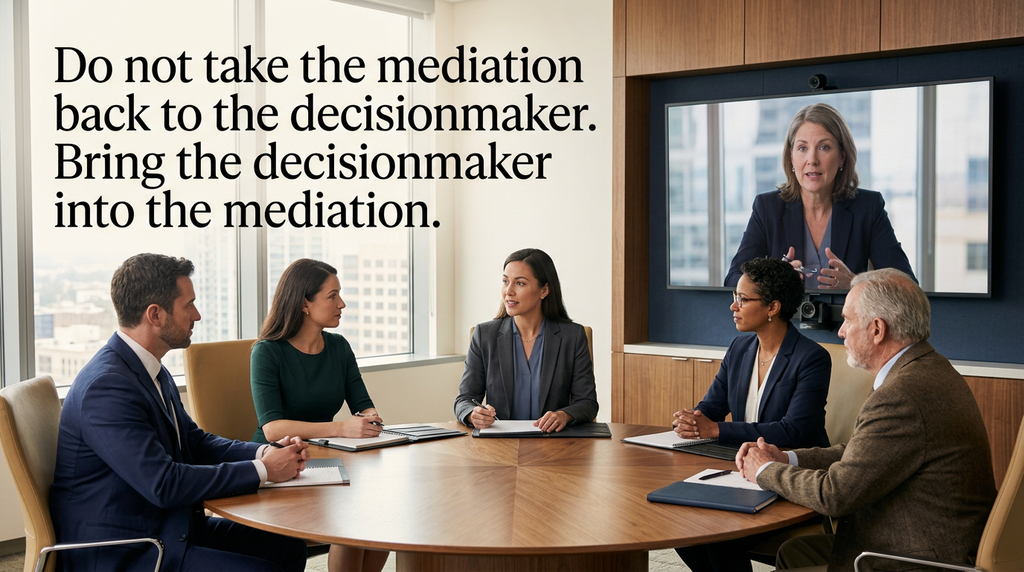
One of the fastest ways to stall a mediation is also one of the most avoidable: failing to include the person who actually has the power—or practical influence—to say yes. That is why part of my pre-mediation preparation includes a direct conversation with each attorney about who will be participating. I want to know who has final settlement authority, whether anyone else must approve a resolution, whether every necessary decisionmaker will be available, and whether there is an outside influence who should participate.
It sounds simple. It rarely is.
Sometimes an attorney intentionally shields a client from the process. Other times, everyone assumes the person attending has sufficient authority without asking whether someone else will ultimately control the decision. That missing person may be a spouse, insurance representative, business owner, senior executive, board member, or another individual whose approval is necessary even if that person is not technically a party. The distinction matters because the person with authority on paper is not always the person with authority in practice.
When the Real Decisionmaker Is Somewhere Else
In one mediation, the plaintiff was present and fully engaged. We made progress throughout the day, and she appeared capable of making her own settlement decision. Then the possibility of an actual resolution became real.
As we moved closer to settlement, she began deferring more and more to her husband, who was not participating in the mediation. Each development required another phone call. Instead of discussing the case directly with the person influencing the decision, I was working through the plaintiff as an intermediary. The process stalled almost immediately.
The problem was not that the plaintiff wanted to consult her husband. That was entirely understandable. Settlement decisions frequently affect more than the named party, particularly when the outcome will have financial or emotional consequences for a family. The problem was that someone with significant influence over the decision was outside the process. He had not heard the discussions, received the same explanations, or developed the same trust in the mediation that his wife had developed throughout the day.
So I asked to speak with him directly.
Once the three of us were on the phone together, I could answer his questions, explain what had occurred, and address his concerns without requiring the plaintiff to translate the conversation. He became part of the process rather than someone evaluating it from a distance. That gave me the opportunity to build trust and explain, from the mediator’s perspective, how we had reached that point. The conversation moved forward, and the case resolved.
Do Not Send the Mediation Back to the Client
A different version of the same problem often arises in commercial disputes. In one corporate matter, neither side brought a client representative to the mediation. The attorneys were prepared, understood the dispute, and made meaningful progress. But near the end of the process, we reached the familiar wall: “I need to take this back to my client.”
At that point, taking the information back to the client is usually the wrong move. Instead, bring the client into the mediation. The client who receives a summary after the fact has not experienced the negotiations. That person has not heard the other side’s explanations, watched positions change in real time, evaluated the mediator’s feedback, or participated in developing the potential resolution.
Instead, the client receives a compressed report from counsel. The conversation may sound something like this: “They started here. We responded there. They are now willing to settle for this amount. What do you want to do?”
That summary may be accurate, but it cannot recreate the process that produced the proposal. The context, momentum, and hard-earned understanding developed during the mediation are lost.
A mediator can only do so much when working through a messenger.
Settlement Authority Is More Than Permission to Move Money
When attorneys discuss settlement authority, they often focus on numbers: Does the representative have authority up to a particular amount? That is important, but it is not the only question.
Real settlement authority also means having the ability to evaluate risk, reconsider assumptions, respond to new information, and approve creative terms. A representative with a predetermined ceiling—but no ability to request additional authority or discuss alternative structures—may not be the decisionmaker the mediation requires.
This is especially important in disputes where the potential resolution involves more than money. A commercial settlement might include revised business terms, future obligations, payment schedules, confidentiality provisions, releases, non-disparagement language, or an ongoing relationship between the parties. If every proposed term must be relayed to someone outside the mediation, the process becomes slower and less effective.
The negotiation stops being a conversation and becomes a series of messages.
Why Direct Participation Changes the Process
Mediation is not merely the exchange of offers and demands. It is a process of gathering information, testing assumptions, evaluating risk, and building enough confidence for the parties to make a difficult decision. A person cannot fully participate in that process through periodic summaries.
When the decisionmakers are present, the mediator can learn what is actually driving the decision. Is the obstacle the amount of money, the proposed terms, a concern about precedent, an emotional issue, or uncertainty about the facts? Sometimes the stated objection is not the real impediment. Direct conversation allows the mediator to identify that distinction.
Participation also lets the decisionmaker hear difficult information firsthand. Counsel may understandably soften a message when reporting it to a client. A mediator can deliver the same information candidly while also explaining the reasoning behind it and giving the client space to respond.
That exchange is often where movement begins.
Who Needs to Be Included?
Before the mediation, counsel should look beyond the person who technically holds settlement authority and ask several practical questions:
- Who must approve a final agreement?
- Who could effectively veto the resolution?
- Whose opinion will the client seek before saying yes?
- Does an insurance representative need additional authority from a supervisor?
- Does a business representative need approval from an owner, executive, board, or committee?
- Are there non-monetary terms that require input from someone who is not currently planning to attend?
If one of those individuals cannot participate for the entire mediation, arrangements should be made in advance to have that person available at a meaningful time. A planned video or telephone appearance is far more effective than trying to locate someone unexpectedly after negotiations have already reached a critical point.
Bring the Decisionmaker Into the Process
Not every mediation will settle simply because the right people attend. Difficult facts, significant valuation differences, unresolved discovery, and countless other issues may still prevent a resolution.
But a mediation should not fail because the person who could approve—or effectively prevent—the agreement was never meaningfully included. Before the session begins, identify who truly needs to participate. Do not wait until the parties are approaching a resolution to discover that someone else controls the answer.
Do not take the mediation back to the decisionmaker. Bring the decisionmaker into the mediation.