
Trial v. Mediation: The Employee’s Mental Health
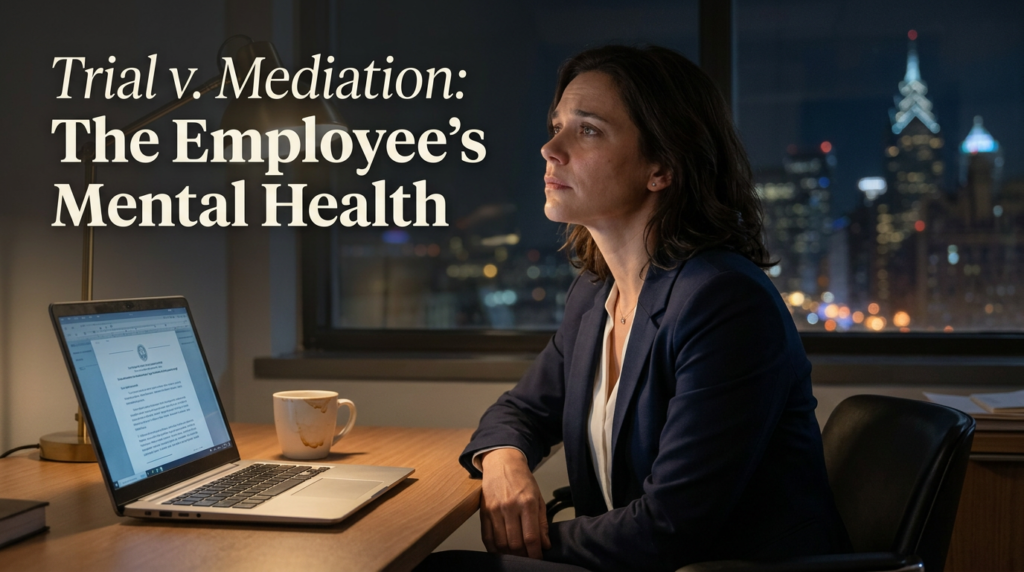
It’s 2 a.m. Your client isn’t thinking about EEOC charge deadlines or discovery timelines. They are replaying the meeting where they were told their position was being eliminated just three months after they filed an internal complaint. They’re wondering whether a jury will believe them, asking whether the professional identity they built over a decade survived the day they were walked out of the building, and calculating how much longer their savings will hold.
That is the person sitting across from you.
In a previous post, I explored what litigation does to business owners in commercial disputes—the operational disruption, the relational cost, the psychological toll of living inside a lawsuit while trying to run a company. Today, I’m focusing on a different client: the employee who has filed an employment claim.
Discrimination. Wrongful termination. Hostile work environment. Retaliation. The legal category matters less than the human reality: this person has already been through something. And the litigation process, if it runs its full course, will ask them to go through it again in more detail in front of strangers, and under cross-examination.
Before a case proceeds to trial, it’s worth asking honestly: can your client truly afford — emotionally, professionally, and financially — to see it all the way through?
That question matters especially in Philadelphia and across the tri-state region. From the financial services firms along Market Street to the healthcare networks spread across South Jersey and the tech corridor growing through Delaware County, employees here are embedded in tightly networked industries where professional reputation travels fast. What happens in an employment dispute rarely stays contained to the parties, despite that confidentiality agreement.
Your Client Had a Career. Now It’s Evidence.
For most employees who file employment claims, the decision to do so wasn’t made quickly. It followed months — sometimes years — of internal complaints, attempts to resolve issues quietly, and the reluctant conclusion that nothing was going to change. By the time the charge is filed, the client is often already depleted.
Litigation doesn’t relieve that depletion. It converts it into a formal process with deadlines, depositions, and document productions. That process requires your client to do something psychologically demanding: to transform the most painful experiences of their professional life into a legal record. Every incident, every email, every conversation they tried to forget — it all has to be reconstructed, documented, and argued about. Repeatedly.
Consider Sarah, a mid-level manager at a Philadelphia-area professional services firm who filed a discrimination claim after being passed over for promotion in circumstances she believed were tied to her pregnancy. Within weeks of retaining counsel, Sarah was spending her evenings organizing performance reviews, pulling text messages, and writing detailed chronologies of conversations she had tried to move past. She wasn’t sleeping, wasn’t present with her family. She had started a new job, but the lawsuit was with her in every meeting and interaction with her new manager.
The case hadn’t gone to trial yet. The damage was already happening.
The Stress Your Client Isn’t Telling You
Many employees who file employment claims won’t fully disclose the emotional weight they’re carrying. There is often a complicated layer of shame, self-doubt, and fear beneath the legal narrative. They may wonder whether they handled the situation correctly, or worry that expressing vulnerability to their attorney will affect how the case is handled, or that their credibility depends on projecting strength.
Recognizing the signs — distraction, emotional volatility, and difficulty engaging with case strategy — is as important as knowing the legal posture.
The Compounding Effect
Stress doesn’t stay confined to the hours your client spends working on the case. When someone is carrying the weight of an open employment dispute, it shows in how they engage with family, how they show up at their new job, and how clearly they make decisions. Many employees in active employment litigation describe a persistent background anxiety. That dread, sustained over months or years of litigation, has measurable consequences for mental and physical health. See https://pubmed.ncbi.nlm.nih.gov/9565919.
The Professional Identity at Stake That No Verdict Can Restore
Here is the dimension of employment litigation that doesn’t appear on a cost-benefit analysis: many employees had a genuine emotional investment in the organization they’re now suing. They believed in the work and built relationships. They identified professionally with what the company stood for, or at least with what it once meant to them.
Litigation requires them to frame that organization and specific people within it as adversaries. That reframing is necessary, but it isn’t free.
When Winning the Case Means Losing Something Else…
Your client may prevail at trial. They may receive a significant damages award, attorney’s fees, and public vindication. And they may also end up with a jury verdict that doesn’t address the things that actually matter most to them: an acknowledgment that what happened was wrong, a genuine apology, clarity about what will be different going forward. A legal win and an emotional loss can happen at exactly the same time.
The Reputational Dimension in Tight-Knit Markets
In Philadelphia’s interconnected professional landscape, employment litigation is rarely invisible. Former colleagues know. Recruiters notice. A case that goes to trial becomes part of the public record in ways that follow both parties. For an employee who is rebuilding their career, a protracted public dispute can complicate the very future they were fighting to protect.
When Is an Employment Case Ripe for Mediation?
Mediation and litigation are not mutually exclusive. The idea of negotiated resolution can be introduced at virtually any point in the process, including through the EEOC’s voluntary mediation program before formal litigation begins. Mediation often works best after both parties have enough information to negotiate meaningfully, but before the costs and entrenchment of trial preparation make compromise feel impossible.
Signs a Case May Be Ripe
- The employee’s primary needs aren’t purely monetary: acknowledgment, an apology, a reference letter, a policy change, or a structured narrative about their departure may matter as much as monetary damages.
- Litigation costs are beginning to approach the realistic range of potential recovery.
- The ongoing psychological toll is becoming a liability: the client’s health, career, and relationships are visibly suffering.
- Both parties have something real to lose from a trial outcome, including reputational exposure and the risk of a public record.
The Attorney’s Role in the Conversation
Raising mediation with an employee-client is not a concession on the merits. It is a strategic recommendation from a trusted advisor who understands that the goal is not just a verdict, it is the best possible outcome for this specific person’s life and career. Mediation is not about giving up leverage; it’s about using it differently.
How Mediation Directly Addresses the Mental Health Toll
The adversarial structure of employment litigation is itself a source of psychological harm. Mediation replaces that structure with something designed differently: a process in which all parties are working toward resolution.
Speed Matters for Mental Health…
Mediation resolves disputes in a fraction of the time litigation requires. The sooner your client can stop living inside the lawsuit, the sooner they can fully invest in what comes next.
What a Court Can’t Order, But Mediation Can Deliver
A court can award damages. It cannot order an employer to issue a written apology, revise an internal policy, or agree on how the employee’s departure will be characterized. In mediation, all those outcomes are available.
What Philadelphia Employees and Their Attorneys Should Know…
Mediation is not a fallback option for weak cases. It is a deliberate, strategic tool that, introduced at the right moment, frequently produces better outcomes than a trial, and does so while protecting the client’s health, career, and relationships. The EEOC’s mediation program settles approximately 70% of participating cases, and private mediation in employment disputes has comparable rates when both parties are genuinely motivated to resolve. See https://www.eeoc.gov/2024-annual-performance-report.
Philadelphia and the tri-state region have strong mediation resources. What employees and their attorneys sometimes lack is the early, honest conversation that puts mediation on the table before the client has been carrying the case so long that the psychological damage has already been done.
What Your Client Gains Beyond Settlement
The resolution of the legal claim is the floor, not the ceiling. With Ari Sliffman at AJS Resolutions, employment mediations are designed to generate options that help the employee actually move forward, with their professional reputation intact and their energy redirected toward the future. The goal isn’t just a signed agreement. It’s a foundation for what comes next.
Setting Expectations Early
The most effective mediation conversations begin at the first client meeting and not after two years of litigation and a trial date looming. Introduce mediation as a realistic pathway from day one. Let your client know what it involves, when it tends to work best, and what it can protect. That conversation costs nothing and gives your client something they desperately need in the early stages of a dispute: a sense that there is more than one way through this.
Ready to Talk About Your Client’s Case?
If you represent an employee who is carrying the weight of an open employment dispute, let’s talk. At AJS Resolutions, we work with employment counsel across Philadelphia, South Jersey, and the tri-state region to find the right approach for mediation. With Ari Sliffman at AJS Resolutions, we work with employment counsel across Philadelphia, South Jersey, Montgomery County, Delaware County, and Chester County to find the right moment and the right approach for mediation.
Book a session or reach out directly to discuss whether your case is ready. Your client has already been carrying this long enough.