
Is It Past Time for Virtual Mediations?
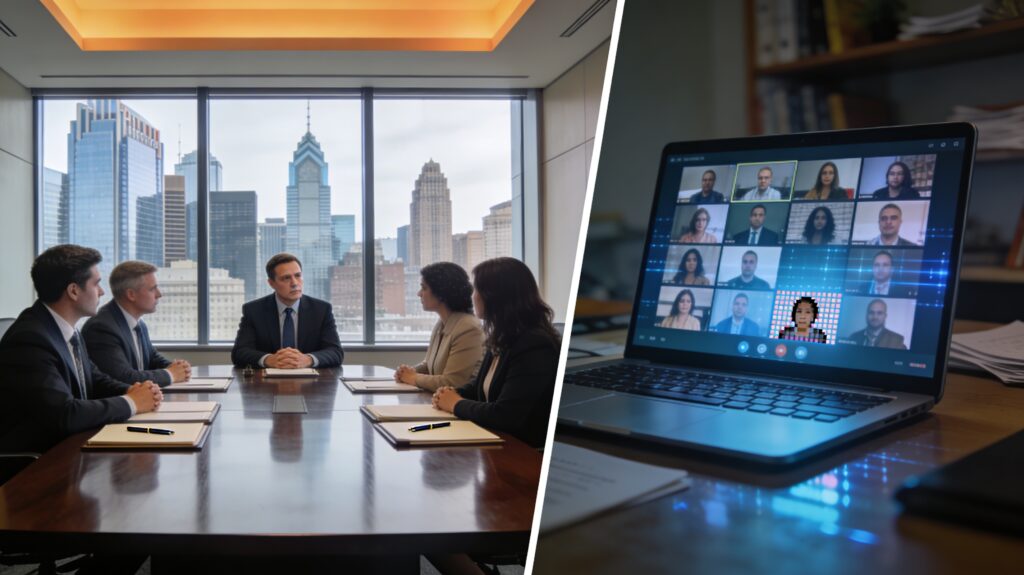
Virtual mediation was a lifeline when the world shut down in 2020. Six years later, it’s worth asking an uncomfortable question: are we still choosing it because it works best or because it’s convenient?
Across Philadelphia, attorneys are streaming back into courtrooms at the Eastern District of Pennsylvania and Philadelphia County Court of Common Pleas. Major law firms that went fully remote are now requiring in-person attendance. The message from the legal profession, broadly speaking, is clear: some things work better when people are in the same room. Mediation is one of them.
This post makes the case for returning to in-person mediation as the default; not as a nostalgic preference, but as a strategic one.
The Virtual Mediation Boom — And Its Hidden Costs
When COVID-19 arrived, the legal community did what it had to do: it moved dispute resolution online. Virtual mediation platforms kept cases moving when courts were closed and travel was impossible, and they deserve credit for that. But necessity birthed a habit, and that habit deserves scrutiny. Virtual mediation does offer real advantages. It eliminates travel time, reduces costs, and makes scheduling across geographies dramatically easier. Those benefits are genuine, and they explain why Zoom mediations remain popular even now.
But convenience is not the same as effectiveness. A survey by the International Mediation Institute found that 42% of mediators report difficulty building rapport online. Rapport is not a soft skill, it is the engine of the entire process. When rapport breaks down, momentum stalls, and settlements that could have been reached aren’t. The savings in travel time don’t offset a failed mediation.
Buy-In Starts Before the First Offer
Here is something every experienced mediator knows: the most important moments in mediation often happen before anyone makes an offer.
The decision to drive to a neutral location in Philadelphia or King of Prussia, find parking, walk into a professional conference room, and sit down across from the other side; these acts carry weight. It signals: I am taking this seriously. It creates psychological investment in the outcome before the opening session even begins. Parties who have made that effort are more inclined to stay at the table when things get hard.
The contrast with virtual mediation is stark:
- Logging on from a home office requires almost no commitment
- The one-click exit is always available; virtual parties can disengage at any moment with zero social friction
- Pre-session connection: the hallway conversation, the small talk before the opening, the moment when you realize the other side is a real person. This rarely happens on Zoom
- The mediator’s ability to build early rapport with both sides, individually, is dramatically compressed in a virtual format
- Momentum compounds in person; once a party has invested a full morning in mediation, they are motivated to finish. That dynamic does not exist when someone is sitting at their kitchen table
Consider the difference: a party who drove 45 minutes to a mediation and has been in the room for three hours is going to work harder to reach a deal than one who joined a Zoom link from their couch and can disappear at 4:00 PM. Buy-in is not a byproduct of mediation, it is a precondition for it. And in-person mediation manufactures buy-in from the moment a party walks through the door in a way virtual simply cannot replicate.
The Body Language Problem — What Zoom Can’t Read
There is one genuine advantage to virtual mediation worth acknowledging: on a video call, a mediator can observe each participant’s face in a separate screen tile, making it easier to monitor reactions without obviously shifting attention away from the speaker. In a conference room, looking across the table at someone other than the person talking can send the wrong signal.
That said, virtual platforms fundamentally flatten human communication in ways that matter for mediation. Body language — posture, the tension in someone’s shoulders, the way a party leans forward when they’re engaged or back when they’re shutting down — is almost entirely lost on Zoom. Silence, which a skilled mediator reads as a tool, is awkward and ambiguous on video. Eye contact, the most direct signal of trust and sincerity, is structurally impossible through a webcam since looking at the camera means not looking at the person, and vice versa.
Most importantly, virtual settings eliminate the organic side conversations that provide some of the most useful intelligence in a mediation: the whispered exchange between an attorney and client, the body language shift after a number is floated, the moment when a party’s posture changes and you know they’re ready to move. Those signals do not survive a screen.
Control the Environment, Control the Process
Experienced mediators know that managing the environment is part of managing the dispute. In person, a skilled mediator controls the room. Virtually, they don’t control much at all.
Here is what in-person mediation gives that virtual cannot:
- No technology failures — dropped calls, frozen screens, and audio glitches are among the top complaints in virtual mediations
- No home-office distractions — children, phones, doorbell deliveries, and open browser tabs break concentration and, more importantly, signal to the other side that you’re not fully present
- Fluid caucusing — moving a party from the main conference room to a smaller side room is natural, discreet, and maintains momentum; virtual “breakout rooms” feel abrupt and clinical
- Real document review — presenting a damages spreadsheet, walking through a contract clause by clause, or reviewing an expert report side by side is dramatically more effective in person than over a shared screen
- Private sidebar access — in the hallway between sessions, attorneys and mediators can speak candidly in ways that a “private message” or a separate phone call simply cannot replicate
The mediation environment is a tool. In-person mediation lets the mediator use it.
Emotional Resolution Requires Human Presence
Not every dispute is purely transactional. Many business and legal conflicts carry an emotional undercurrent — a sense of betrayal, damaged pride, or unresolved tension — that shapes how parties negotiate, even when the conversation stays focused on dollars.
Parties who feel genuinely heard, not just listened to through a screen but acknowledged in the same physical space, are more willing to reach resolution. Closure, particularly in high-stakes cases, is often as much about feeling that the process was serious and respectful as it is about the final number.
This matters acutely in Philadelphia’s tight-knit business and legal community. Many disputes here involve parties who have done business together for years, who share clients, or who will encounter each other again at industry events or in the courthouse. A mediation that ends with a durable agreement, and a relationship that can survive, is worth far more than one that reaches a number but leaves lasting resentment. Virtual mediation manages conflict at a distance. In-person mediation can actually resolve it.
When Virtual Mediation Still Makes Sense
This is not a blanket dismissal of virtual mediation. There are cases where it is clearly the right call:
- Parties are geographically dispersed — across multiple states, internationally, or in locations where travel creates genuine hardship
- The dispute is narrow and document-driven — a straightforward contract interpretation or a defined damages calculation with no meaningful emotional component
- Time is critical — when delay would cause harm and scheduling an in-person session quickly is not feasible
- Accessibility limitations — a party’s medical condition, mobility, or other personal circumstances make in-person attendance genuinely difficult
For those situations, virtual mediation is a valuable tool. Use it.
But for most commercial disputes involving Philadelphia-area businesses, New Jersey parties, or Delaware corporate litigants, those exceptions don’t apply. Geography is rarely an obstacle in the tri-state area. The disputes are rarely simple. And the relationships at stake usually deserve better than a Zoom call. In-person remains the gold standard and it is almost always within reach.
Ready to Resolve Your Dispute the Right Way?
If you’re an attorney or business owner in Philadelphia, South Jersey, or general Delaware Valley navigating a commercial dispute, contract conflict, or business relationship breakdown — let’s talk. Reach out to me at asliffman@ajsresolutions.com or call at 267-681-0890. If you’re ready to book, schedule HERE with my real-time availability.